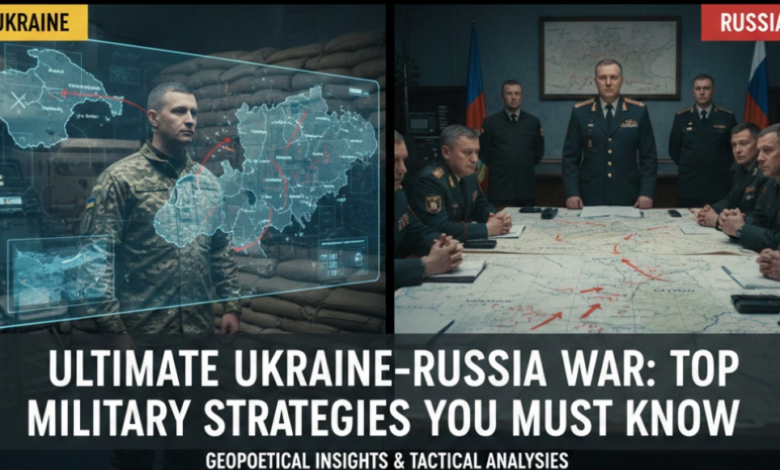
Ultimate Ukraine-Russia War: Top Military Strategies You Must Know: conflict with applicability related to the situation in Ukraine and Russia as of 2022 has had the effect not only of redefining political dynamics globally but also of thrusting military strategy into the limelight. Each country has adopted its own approach that is based on the goals, capabilities, and political considerations that take precedence for them. Read More..
Ukraine’s Defensive Tactics
Since the onset of the conflict, Ukraine has retained a defensive approach to the conflict by taking advantage of both conventional and asymmetrical methods. These include:
Fortifying Key Cities and Infrastructure
Large cities such as Kyiv, Kharkiv, and Mariupol were reinforced through the use of barriers, minefields, and strategically erected checkpoints, thus hindering the Russians’ progress, in addition to reducing civilian deaths.
Use of Local Knowledge
The Ukrainians know the terrain and have established points of attack and defense along the forests, rivers and cities. The Ukrainians who are fewer in number, have been able to attack the Russians, who are many.
Precision and Mobility
Although it has fewer heavy arms than Russia, Ukraine has been fighting through mobile troops with anti-tank rockets and drones and has been following a hit-and-run tactic that has resulted in far more causalities without being engaged by superior forces.
Cyber and Intelligence Warfare
Ukraine has leveraged intelligence-sharing efforts from their Western allies. Satellite imagery, real time reconnaissance, or cyberattacks have created numerous advantages for Ukraine to make accurate hits or change their defense strategies.
Russia’s Offensive Operations
Russia, feeling confident about its advantage in resources and heavy weaponry, had originally conducted an aggressive strategy involving quick attacks to secure the capture of major cities in the country. The key factors involved are:
Massed Armored Assaults
Tanks, infantry fighting vehicles, and artillery were deployed on a large scale in breaking through the defensive positions. However, this was strongly countered by the defenses set up by Ukraine.
Air and Missile Strikes
Russia’s main approach to weaken the position of the Ukrainians has relied on air bombardments and missile attacks as a means of creating psychological pressure and undermining the will of the troops and the population.
Encirclement Tactics
Besides the conventional military engagement, Russia has used information war and local insurgents to destabilize regions that fall under Ukrainian rule.
Hybrid Warfare
Beyond traditional military action, Russia has employed information warfare, propaganda, and local insurgent support to destabilize areas under Ukrainian control.
The Role of Western Support
An important determinant in the strategy adopted by the Ukrainian government is external aid in terms of military equipment. The delivery of state-of-the-art weapons such as HIMARS rocket launchers, anti-tank missiles, and drones has been critical in improving the country’s defenses. Capacity building by members of NATO organizations has been important in this respect.
Adaptation and Evolution
One of the most striking aspects of the Ukraine-Russia conflict is how quickly both sides adapt their military strategies. Ukrainian forces have shifted from purely defensive positions to targeted counterattacks. As a result, they have regained control of several areas previously occupied by Russian troops. The Russians have also modified their strategies to concentrate on bombing and ensuring their logistics.
Both countries have shown that modern warfare has more to offer than just quantity and weapons capabilities. Mobility, intelligence, and morale and the integration of technology play their roles. Humanize Text
Civilian and Urban Warfare Challenges
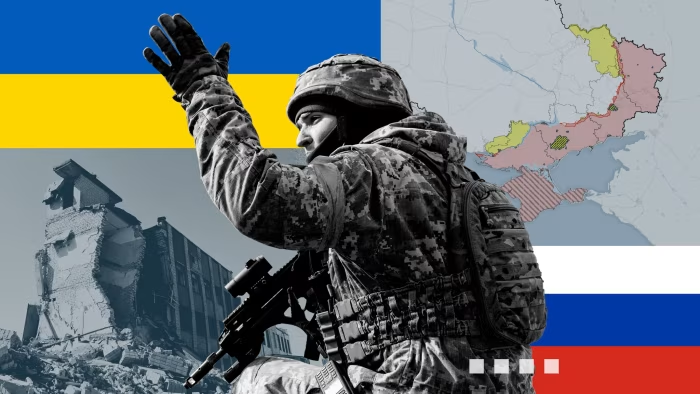
Both sides have faced a set of unique difficulties with respect to fighting in an urban setting. Urban combat areas such as Mariupol raised dilemmas in which Ukraine had to weigh military objectives against civilian safety. In like vein, the challenge of Russian forces was to gain ground, within a heavily populated city where conventional armored maneuvers were constrained. This has led to a reliance on smaller units, snipers, and artillery support rather than broad frontal assaults.
Lessons in Modern Warfare
- Asymmetric tactics can offset numerical disadvantages: Ukraine has been able to hold its ground with the help of drones, anti-tank missiles and mobile troops against larger formations of Russia.
- Technology and intelligence are force multipliers: Technologies such as satellite imaging, cyber warfare and communication in real time really do represent the Lego of modern warfare.
- Urban warfare is complex and resource-intensive: Controlling the cities requires elaborate planning. Logistics are often slow because operations are seriously slowed down in order to protect civilians.
- Adaptability is key: The sides have modified strategies in response to battlefield realities and proof that flexibility frequently does make up for rigid planning.
Conclusion
The war between Ukraine and Russia is a reminder that military strategies have changed significantly with time. The war combines classic armored attacks and asymmetrical attacks. The Ukrainian defenses and response strategies demonstrate its resilience. Russia’s attack strategies demonstrate that even invasion in the 21st century has its pitfalls.
In conclusion, the conflict tends to show how innovation, intelligence, and global alliances can make a difference in warfare. The conflict remains a subject for study globally for people interested in warfare to derive a lesson from it .